
"What makes you think a writer isn't a salesman?" —Kurt Vonnegut
Welcome!
Below are three of my favorite pieces of mine. Please click through to read further,
or visit my content page to see more of my work as a creative writer and essayist.
Visualizing the Arab Spring
Beirut-born artist Helen Zughaib returned to her homeland in the early days of the Arab Spring. Almost immediately, she began working on gouache paintings centered around a character, Abaya, named for the black cloak worn by many Arab women. Standing in as the witness of all the hope and loss of the Arab Spring, Zughaib’s thrilling use of color is juxtaposed by the tragic conclusion to nearly all of uprisings.
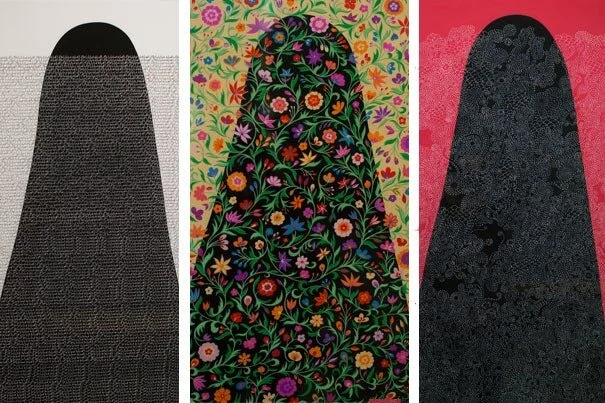
A selection from a series of portraits of a cloaked woman—"Veiled Secrets," 2013, "Arab Spring," 2011, and "Arab Spring Quilt," 2015—from the exhibit Arab Spring/Unfinished Journeys by Arab-American artist Helen Zughaib about the democratic uprisings in the Arab world between 2010 and 2013.
Stephanie Mitchell/Harvard Staff Photographer
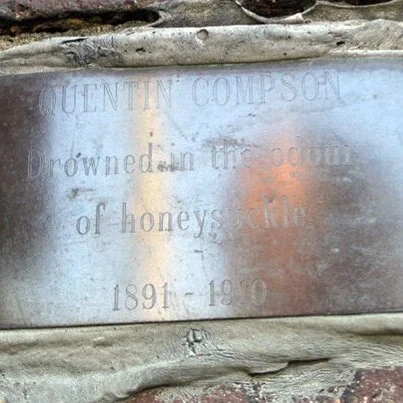
For more than 50 years, the Harvard community has helped to preserve a plaque on the Anderson Memorial Bridge memorializing Quentin Compson, the tragic hero of some of William Faulkner's most influential fiction. Wikimedia Commons
The Mysterious Journey of Quentin’s Plaque
Since 1965, a small memorial to a fictional character has been the site of a pilgrimage of sorts for Harvard’s literature students. No one knew who put it there until it disappeared during a 1980s renovation of the bridge, and suddenly a hidden contingent of the Harvard community emerged to discover its origins and see it replaced. When history repeated 30 years later, the next generation of Quentin’s memorializers (including yours truly) sprang into action, and worked with the University and the Massachusetts Department of Transportation to ensure that the memorial would be there for decades to come. (Fun Fact: I now possess this plaque in the thumbnail.)
Women’s Iran, 1980s vs. 2010s
At just 24 years old, Randy Goodman was asked by her former professor William Worthy Jr. to join a team en route to Iran to document the rapidly unfolding hostage crisis at the U.S. Embassy. Her photos of the inside of the embassy, the Iran-Iraq war, and the daily life of Iranian women and girls were published worldwide and catapulted her to fame. Over 30 years later, in the wake of the short-lived nuclear deal signed by the Obama administration, Goodman returned to Iran to document how life has changed for women in the 21st century.
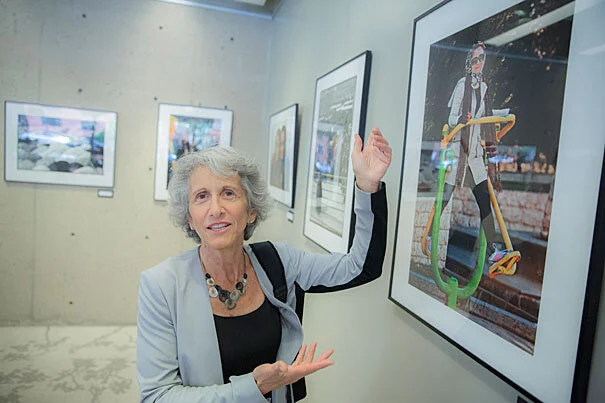
Photojournalist Randy H. Goodman returned to Iran after 33 years to see how life has changed for women since her visits to the country to document the hostage crisis at the U.S. embassy and the Iran-Iraq War.
Kris Snibbe/Harvard Staff Photographer